





When Australian tech companies are small, everything feels connected. Founders sit next to sales and marketing, there are only a handful of campaigns, and almost every activity looks and feels close to revenue.
As MSPs, vendors and distributors scale across states, sectors and partner ecosystems, that informal alignment snaps. Budgets grow, calendars fill, yet growth quietly feels fragile. You see more activity, but you’re less certain what’s actually working.
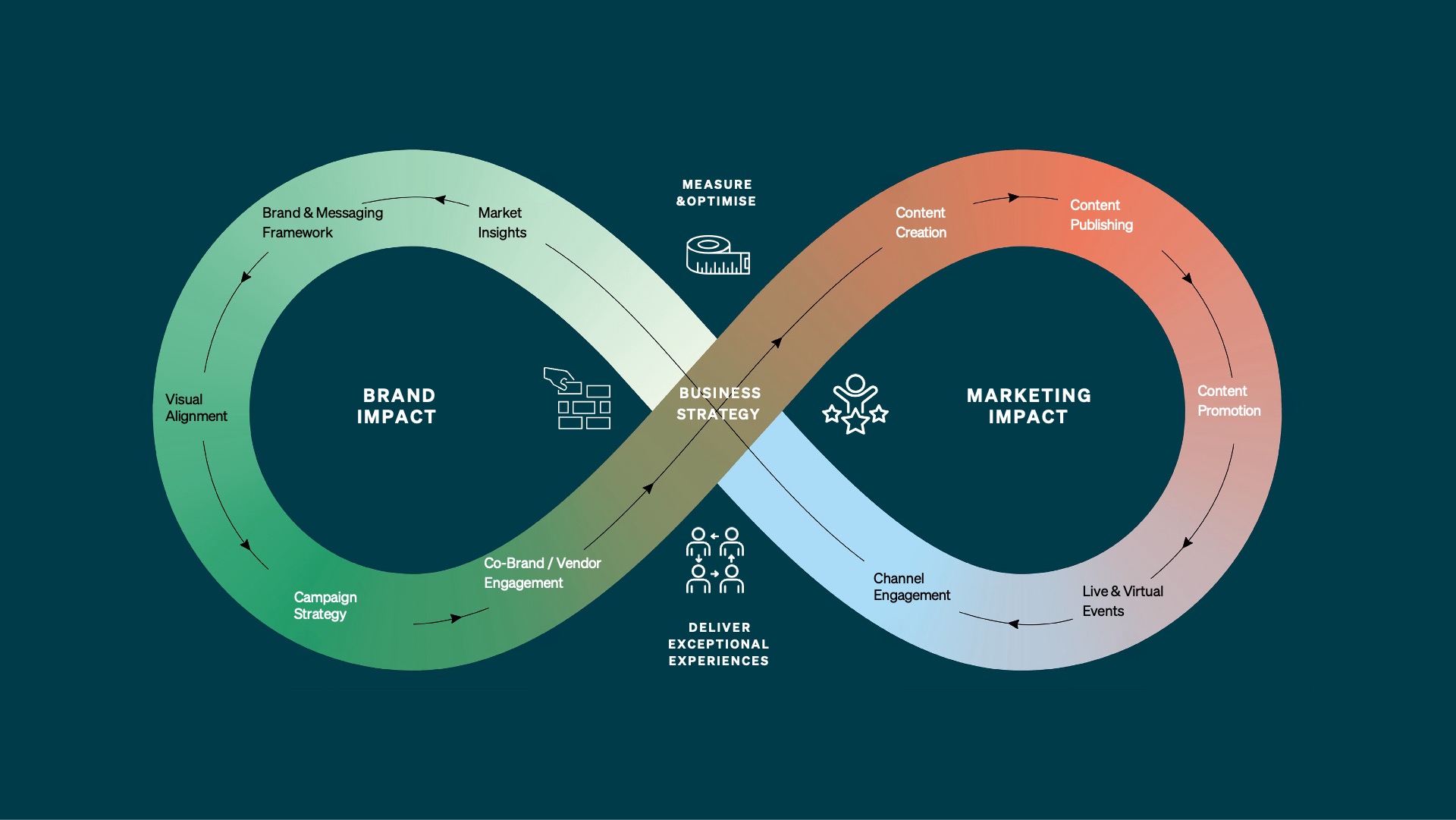
In New Zealand, we’ve argued that tech marketing still confuses activity with impact. In Australia, the same problem appears at scale. What breaks isn’t the strategy or the people. It’s the GTM discipline that should sit between brand impact, business strategy and marketing impact – the very connections shown in our own Impact Loop.
When proximity hides GTM problems
Early on, proximity does the heavy lifting. Everyone shares the same customer stories. Sales feedback loops straight back into marketing. Partners know who to call when something lands.
That closeness is powerful, but it masks structural gaps. The business may never have clearly agreed priority audiences, named GTM plays, or defined who owns what in the channel. The GTM model lives in people’s heads, not in a shared operating system.
As you add new states, vendors, MSPs and distributors, distance creeps in. Decisions that once happened in one room now happen across Australia. The Impact Loop that once held naturally together starts to fray: brand, strategy and execution drift apart.
Benchmark yourself:
- Are your founder stories and your current campaigns telling the same story?
- If you left the room, would sales and partners still describe your GTM priorities the same way?
Where the Impact Loop breaks at scale
Look at the Fabric Impact Loop: brand, messaging and market insights on the left; channels, content and campaigns on the right; business strategy and measurement at the centre. When scale exposes GTM discipline gaps, it usually shows up in a few predictable places.
1. Brand & messaging vs local and partner campaigns
National brand and messaging say one thing; state teams and partners say another.
- NSW focuses on speed, Victoria leads with security, Distributors talk mainly about discounts.
- Each choice makes sense locally, but buyers hear a fragmented story overall.
What to watch for:
- Different taglines or value props across decks, landing pages and partner kits.
- Sellers and MSPs creating their own “version” of your story because the official one “doesn’t quite fit here.”
Impact Loop lens: your Brand & Messaging Framework isn’t consistently informing campaign strategy and partner execution.
Benchmark question:
- Could a buyer in Sydney and Perth describe your value proposition in roughly the same way?
2. Market insights vs priority audiences
You invest in market insights, but as you scale, every region and partner seems to have its own view of the “top” sectors.
- Vendors want to chase enterprise; MSPs prefer mid‑market; Distributors push whatever moves this quarter.
- Budgets spread thin, and no audience feels a sustained presence.
What to watch for:
- Planning meetings where the “priority” list only ever gets longer.
- Confusion when you ask, “Who are the three audiences we must win in Australia this year?”
Impact Loop lens: Market Insights are not turning into clear, shared priority audiences and problems that shape GTM plays.
Benchmark question:
- Do sales, marketing and your key partners agree on the same top three audiences and problems?
3. Campaign strategy vs channel and distributor execution
On the right side of the Loop, campaign strategy is meant to guide channels, content and events. At scale, those elements often fragment.
- Paid, email, events and Distributors all run “their thing” under a loose campaign banner.
- Launch dates, CTAs and offers vary, and no‑one owns the full buyer journey.
What to watch for:
- Channels going live at different times with different CTAs for the “same” initiative.
- No single person who can explain how a prospect moves from first touch to sales conversation.
Impact Loop lens: your Campaign Strategy is not flowing cleanly through Channel Engagement and Content Promotion; pieces of the loop spin independently.
Benchmark question:
- For your biggest current campaign, can someone trace a clear journey from first touch to sales and renewal?
4. Content creation vs sales and partner enablement
Content creation and publishing should feed real sales and partner conversations. But in many AU tech organisations:
- Marketing content lives in tools; sales teams and MSPs rely on their own decks and talk tracks.
- National campaigns and what’s said in meetings don’t match.
What to watch for:
- Partners saying “we didn’t know that was live” or “we use our own deck.”
- Sellers defaulting to legacy materials because they can’t find or don’t trust the new ones.
Impact Loop lens: Content Creation isn’t closing the loop into Deliver Exceptional Experiences and Channel Engagement.
Benchmark question:
- If we asked your top MSP or Distributor to pitch your current campaign, would it sound like your brief?
5. Measurement vs decisions
At the centre of the Loop sits Measure & Optimise. At scale, this can become a rear‑view mirror instead of a steering wheel.
- Reports describe what happened – impressions, clicks, registrations, pipeline.
- They rarely answer what to stop, what to double‑down on, or which GTM plays to scale.
What to watch for:
- Long reports with no clear recommendations.
- Different teams holding different views of which activities “worked.”
Impact Loop lens: measurement isn’t being used to tune the whole loop – brand, strategy, channels and partner activity just to justify past spend.
Benchmark question:
- Do your monthly reports clearly tell you which plays to stop, start and scale?
GTM discipline: how MSPs, vendors and distributors close the loop
None of these problems are creativity issues. They are GTM discipline issues. The fix is not “more campaigns,” it’s an operating model that keeps the Impact Loop intact as you grow.
For MSPs, Vendors and Distributors, GTM discipline looks like:
- Shared priority audiences and problems for Australia that everyone signs up to, not just marketing.
- Named, repeatable GTM plays (e.g. “Renewal Defence – AU Mid‑Market”, “New Logo – Co‑Sell with MSPs”) that tie brand story, content, channels and sales actions together.
- Joint ownership of outcomes across the channel: opportunity creation, conversion, revenue and retention – not just MQLs or shipped leads.
- Fewer initiatives, run deeper with partners, reviewed honestly against pipeline, margin and customer experience.
When you do this, the Impact Loop stops fragmenting. Brand informs GTM plays, plays guide campaigns and partner motions, and measurement helps you refine the whole system, not just individual tactics.
When growth feels fragile, benchmark your Impact Loop
If your Australian GTM feels busy but brittle, it’s time to benchmark yourself against best practice rather than launch the next campaign.
Use the questions above as a quick Impact Loop health check across your MSP, Vendor and Distributor ecosystem. If too many answers are “not really” or “not sure,” you don’t have a marketing problem – you have a GTM discipline problem.
That’s exactly what our GTM Discovery Workshop is designed to solve. We map your current GTM against the Fabric Impact Loop, identify fragmentation points, and co‑design a small set of GTM plays that your sales team – and your partners – can actually feel in the numbers.
Contact Us
Share